

Kavli Oxford researchers join £6 million quest to uncover nature’s quantum compass
Kavli Oxford researchers join £6 million quest to
uncover nature’s quantum compass
Researchers at the Kavli Institute for Nanoscience Discovery are contributing to an ambitious new project investigating one of biology’s most intriguing unanswered questions: how animals sense Earth’s magnetic field.
The five-year programme, ‘Quantum sensing in nature and synthetic biology’, is supported by a £6 million Biotechnology and Biological Sciences Research Council Strategic Longer and Larger (sLOLA) grant. Led by Professor Christiane Timmel in Oxford’s Department of Chemistry, it brings together researchers in chemistry, physics, structural biology, engineering and neuroscience from the universities of Oxford, Edinburgh and St Andrews.
The project draws on Kavli Oxford’s collaborative, interdisciplinary environment. Alongside Professor Timmel, Kavli Oxford researchers Andrew Baldwin, Justin Benesch, Mark Hankins, Achillefs Kapanidis, Madhavi Krishnan, and Stuart Peirson, project manager Sabine Huth-Rauschenbach, and laboratory manager Sanna Piippo-Henderson, are part of the broader cross-divisional Oxford team.
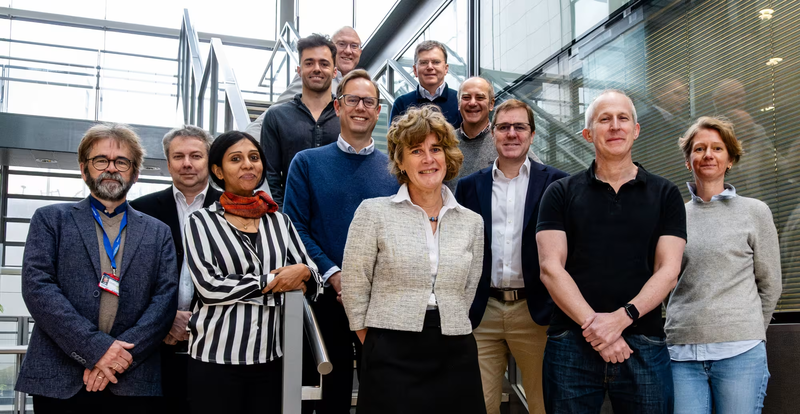
The Oxford team: Mark Hankins, Kevin Henbest, Madhavi Krishnan, Harrison Steel, Andrew Baldwin, Justin Benesch, Christiane Timmel, Chris Schofield, Achillefs Kapanidis, Stuart Mackenzie, Stuart Peirson, Sabine Huth-Rauschenbach. Photo credit: University of Oxford.
Many migrating animals use information from the Earth’s magnetic field to help them navigate. A leading – but incomplete – explanation for light-dependent magnetic sensing centres on a protein called cryptochrome, located in the animal’s eye. When cryptochrome absorbs light, it can form a short-lived pair of radicals, each containing an unpaired electron. The Earth’s weak magnetic field may alter the spin dynamics of this radical pair, affecting the chemical reactions that follow. These changes are hypothesised eventually to generate a biological signal that contributes to magnetic sensing.
The programme team will investigate how a magnetic effect on cryptochrome radical pairs could be translated into biological signalling, neural activity and behaviour. Researchers will compare cryptochromes from plants, insects, birds and mammals, while also exploring whether analogous magnetic responses can be engineered into model proteins.
By connecting processes involving individual electron spins with neural activity and behaviour in living mice, the researchers hope to develop a more complete account of biological magnetoreception. In the longer term, the findings could inform the development of magnetically responsive biotechnologies with potential biomedical uses.

