
Kavli Oxford Lecture Award 2026 Honours Professor Jue Chen
Kavli Oxford Lecture Award 2026 Honours Professor Jue Chen
The Kavli Oxford Lecture Award 2026 has been awarded to Professor Jue Chen for her contributions to understanding the structure and mechanism of ATP-binding cassette (ABC) transporters – ATP-powered membrane proteins that perform a wide range of cellular functions.
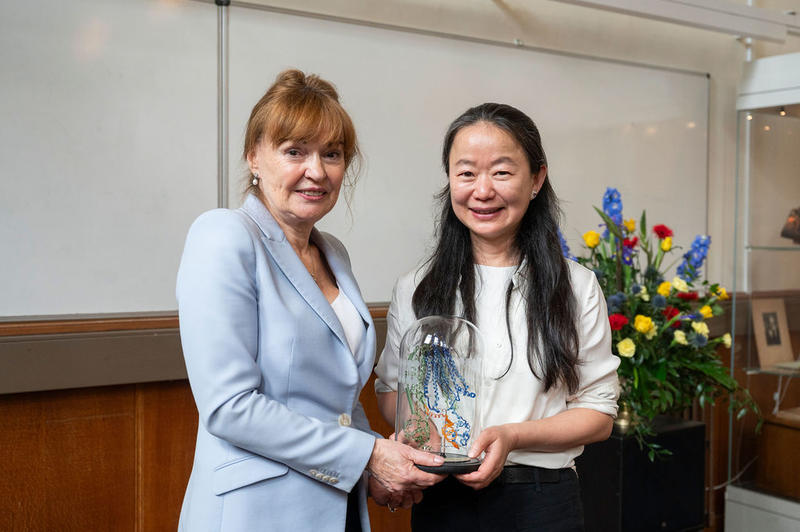
Photo: John Cairns

Photo: John Cairns
On Monday 8 June, Kavli INsD welcomed Professor Chen, William E Ford Professor and Head of the Laboratory of Membrane Biology and Biophysics at Rockefeller University, as our fifth annual Kavli Oxford Lecture Award recipient. Introducing the lecture, Professor Dame Carol Robinson highlighted the significance of Professor Chen’s research, reflecting on its impact in revealing how ABC transporters function in health and disease. In response, Professor Chen spoke warmly of Professor Robinson as ‘an inspiration as a female scientist’, highlighting how she has modelled making career decisions guided by personal values.
After the lecture, following questions from the audience, Professor Chen was presented with a commemorative glass-blown sculpture created by Terri Adams (Department of Chemistry), depicting an ABC transporter and interacting peptide.
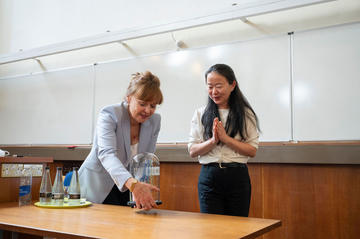
Photo: John Cairns
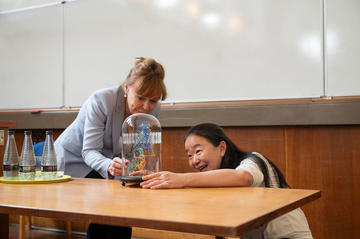
Photo: John Cairns
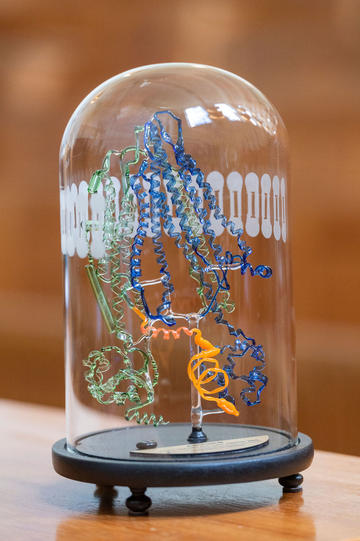
Photo: John Cairns; Sculpture: Terri Adams
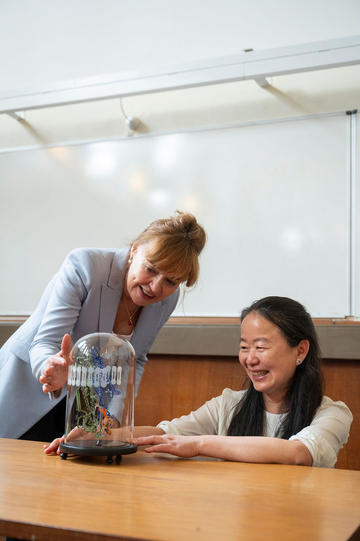
Photo: John Cairns
Lecture summary
Professor Chen began her lecture by highlighting the rich historical body of work on the large family of ABC transporters – a family of proteins that serve to actively transport an unusually broad spectrum of molecules across membranes, powered by ATP hydrolysis. A protein ‘superfamily’, the structures of these transporters are widely conserved from bacteria to humans, and with such widespread functionalities across the family, many of these proteins are linked to a variety of human disorders; most famously, cystic fibrosis.
She focused on two specific ABC transporters from her work, TAP and CFTR, to explore these proteins’ significance and pathological implications, asking how ATP hydrolysis is coupled to the transport of substrates, and how the transporter’s features link to their specific function.
Professor Chen explained that one of the most striking features of the many ABC transporters is their flexible substrate specificity, defined by substrate size, charge and local interactions, rather than specific sequence, for example. In the case of TAP, a transmembrane protein serving to actively load peptides into a cell’s endoplasmic reticulum for antigen presentation by MHC-I on the cell surface, a whole host of different peptides can bind the same channel. Despite having very distinct sequences, the end-termini of these peptides are conserved, enabling anchoring to the same transmembrane domains in TAP – meaning that a cell can signal infection by a vast number of pathogens to immune T cells.
Emphasising the fundamental importance of TAP channels, Professor Chen showed that several of the most elusive human viruses, such as herpes simplex and cytomegalovirus, encode a TAP peptide blocker. Effectively acting as a competitive inhibitor, this blocker sits inside TAP’s catalytic domain, preventing structural conformational change which in turn prevents full assembly into the MHC-I complex – efficiently rendering the infected cell invisible to the immune system.
When structural changes are inhibited, these normally gated transmembrane proteins can become open on both sides, allowing ions to pass all the way through without control – just as is the case with mutated CFTR, seen as cystic fibrosis. Whilst CFTR relies on the transfer of phosphate ions to amino acids to create its gating effect, controlling the movement of chlorine ions out of primarily epithelial cells. With more than 2000 mutations in the CFTR gene potentially leading to cystic fibrosis, dysfunction ranges from gating defects, through to ion conduction and protein misfolding.
To a rapt audience, Professor Chen concluded that in the case of many medical treatments, the exact mechanism of action is still being elucidated. Vertex’s triple-combination TRIKAFTA® is the current most successful treatment for CF, comprising of three molecules that act as correctors and potentiators; in other words, stabilizing the CFTR channel structurally, correcting trafficking to the cell surface membrane and boosting the gating hinge of the pore. Treating more than 178 CFTR misfolding mutations, TRIKAFTA® has opened up the concept of finding stabilizing ligands to treat aberrant channels, which could reveal many more opportunities for targeted drug therapies in channelopathies.
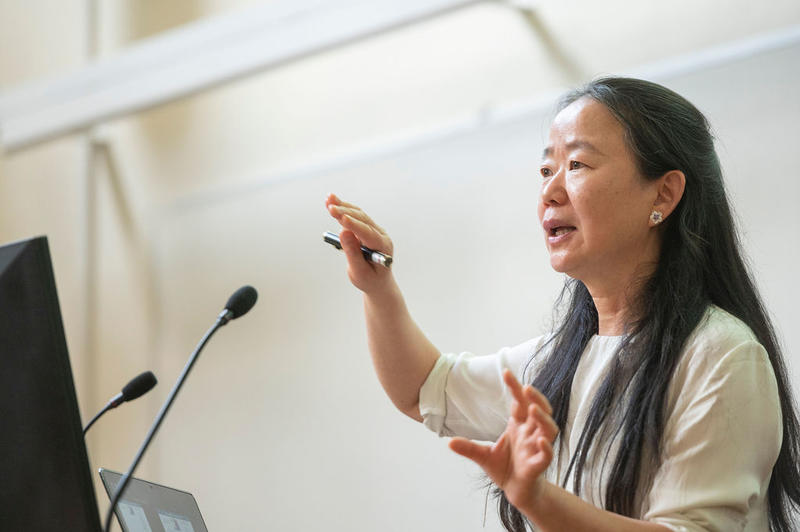
Photo: John Cairns
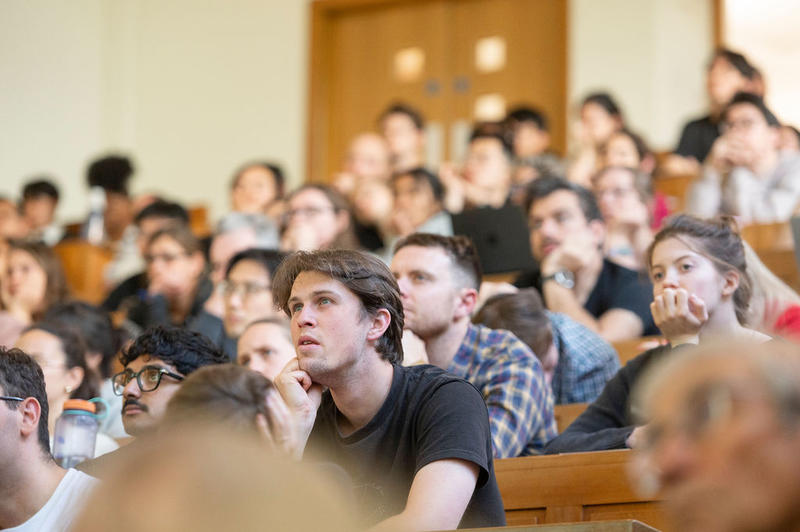
Photo: John Cairns
The Kavli Oxford Lecture Award recognises scientific leadership characterised by curiosity-driven research, interdisciplinary thinking, and a commitment to translating fundamental discoveries into real-world benefits. Details about previous recipients of the award are available on our website.

