

Becky Carlyle appointed Associate Professor
Becky Carlyle: From Oxford Scholar to Associate Professor
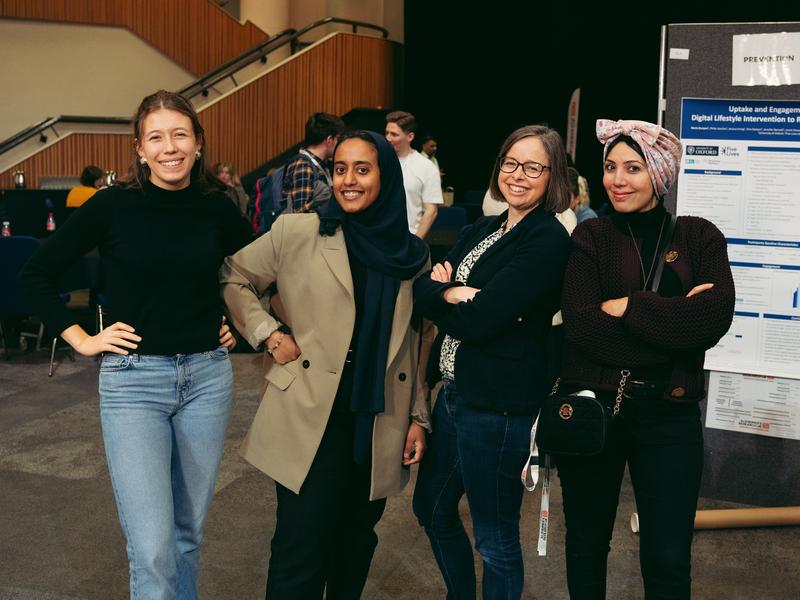
Becky Carlyle with members of her research group
Becoming Associate Professor
Becky Carlyle’s recent appointment as Associate Professor with a Tutorial Fellowship at St Hilda’s College marks a significant milestone in a career defined by curiosity, resilience, and a willingness to take an unconventional path. It is a role that recognises both her scientific leadership in neurodegenerative disease research, and her commitment to education, collaboration, and community.
Early direction
For Becky, as for many high-achieving science students, medicine initially seemed the obvious path, and gaining a place to study medicine at Oxford from a comprehensive school in Bradford was a notable achievement. Once here, however, she found herself increasingly drawn to the biochemistry modules of her BA in Medical Sciences and she began to question whether clinical practice truly motivated her.
Within weeks of starting clinical training in Edinburgh, her suspicions were confirmed and she became convinced that her true interest lay in scientific research. Leaving medicine was a determined and courageous move, but one made in a way that seems characteristic of Becky: carefully weighing the available evidence, reflecting on her own strengths and experience, and then committing fully to a chosen path.
After supporting herself through administrative roles, she eventually secured a PhD in Edinburgh, where she learned — sometimes painfully — the level of independence required in academic research. Scaling back her original project on the schizophrenia risk gene Disrupted in Schizophrenia 1 (DISC1) and the neuronal enzymes PDE4 and GSK3-beta, she completed her doctorate in 2010, at a time of limited academic opportunities. However, her early appreciation of the importance of scientific communities, and the networks she had built within them, proved crucial.
Research focus and approach
It was these networks that led to her move to Yale as a postdoctoral researcher. Working through two laboratories, including in Professor Angus Nairn’s group, Becky gained extensive training in proteomic and transcriptomic analysis of human brain tissue, and she went on to develop the integrated RNA–protein approaches that underpin her current research.
Subsequent work at Massachusetts General Hospital and Harvard Medical School, combining laboratory science with clinical trials, further shaped her approach to science. She argues that thinking about cells in isolation is not necessarily helpful when trying to understand disease, and she actively engages with patients and families to help shape research priorities. This perspective aligns closely with the Kavli Institute’s Ethics & Society work, which explores how scientific knowledge is produced, who is involved, and how trust is built between researchers and the wider public
Becky’s group now focuses on integrating large-scale measures of RNA (transcriptomics) and protein (mass-spectrometry proteomics) to understand the molecular changes in the human brain that increase susceptibility to neurodegenerative disease. Using biochemical fractionation of post-mortem human brain tissue alongside mass-spectrometry, her team investigates disease-associated changes in protein localisation in conditions including Alzheimer’s disease and schizophrenia.
A central theme of her work is cognitive resilience: why some individuals can tolerate high levels of tau and amyloid protein deposition in the brain without developing memory problems. By identifying groups of proteins that appear to protect brain cells, and testing their function in human stem-cell–derived neuronal models, her research aims to reveal pathways that support brain health and that suggest new therapeutic strategies.
Parallel paths
Away from the lab, Becky’s lifelong passion for orienteering reveals another side of her character, or perhaps another expression of the same character that is evident in her work. She was introduced to the sport at a very young age through her father’s army background so she grew up learning how to navigate complex landscapes by making informed decisions under pressure. At just eight years old, she completed a course through a Scottish forest alone after outrunning, and losing, her family.
Her commitment to the sport has continued into adulthood, including competing in World Cup events, helping to establish an orienteering course in Oxford’s University Parks, and her recent selection for the England team for the 2026 Interland competition. There are clear parallels to be drawn between Becky’s description of the demands of international-level orienteering and her approach to research – total focus, careful assessment of available information, the ability to adapt as conditions change and the commitment to reach the end.
Science, society, and community
Becky’s interest in science, education and sport also extends into civic life. She is actively involved in Headington Liveable Streets, motivated by a belief that safe, connected communities matter profoundly for health and wellbeing. Walking and cycling she argues, support social interaction, reduce pollution, and align with her work to reduce Alzheimer’s risk. More broadly, she is concerned about the loss of shared real-world spaces and the opportunities for people to get together – the loss of communities. Her values are not compartmentalised, but shape how she thinks about research, education, and the kind of society she hopes to help build for her son.
With her associate professorship, Becky Carlyle has entered a new phase in which the appointment will facilitate her to continue charting, bold, thoughtful, and sometimes unexpected routes through her life and work. We look forward to seeing where her next project will take her.
Since April 2021, Oxford University's KAVLI Institute for Nanoscience Discovery is proudly serving as a hub for research groups from seven different departments spanning both the medical and physical sciences, including the Carlyle Group from the Department of Physiology, Anatomy and Genetics

